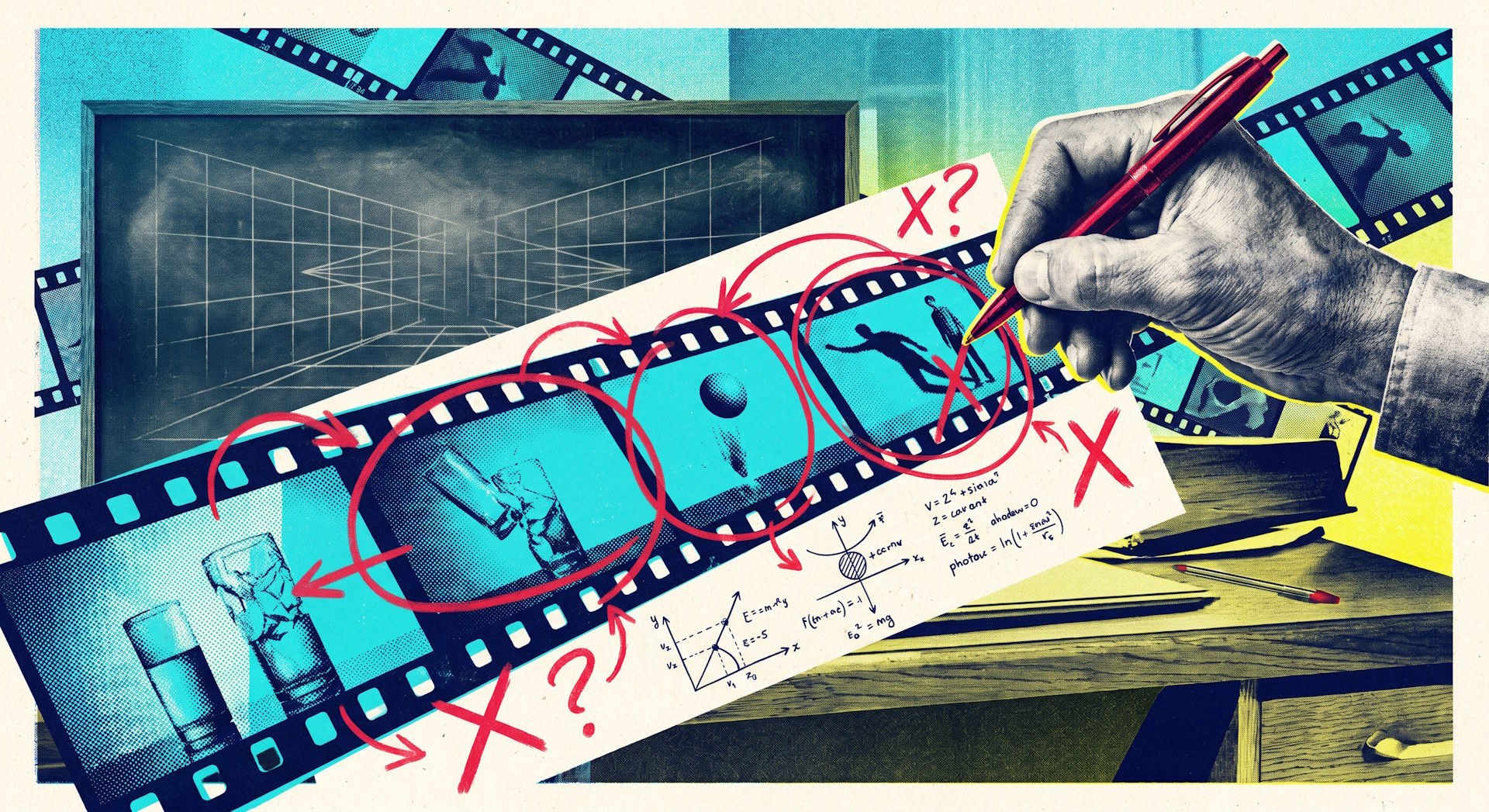
The visual brilliance of today’s video generators is little more than a facade masking a cognitive void. While Sora 2 and Veo 3.1 compete for photorealism, the new WorldReasonBench from Tsinghua University exposes a harsh reality: modern models possess a catastrophic lack of understanding when it comes to physical processes. According to the researchers, even the most sophisticated systems systematically fail tests of basic logic. Standard quality metrics like VLOV or VBench continue to praise AI for beautiful imagery, even if an apple in the frame floats into the stratosphere or pops like a soap bubble. For R&D leaders, the message is clear: these are still pixel generators, not the promised 'world models.'
WorldReasonBench’s methodology targets these vulnerabilities by dividing its assessment into four segments: world knowledge, human-centric scenarios, logic, and information processing. Logical reasoning proved to be the Achilles' heel for every system tested without exception. While commercial players like ByteDance’s Seedance 2.0 scored twice as high as open-source rivals like LTX 2.3 or HunyuanVideo 1.5, this is merely leadership among the weak. While Veo 3.1-Fast leads in academic knowledge and Sora 2 better mimics social gestures, both systems fail at mathematical or geometric precision. As soon as a scene requires maintaining a cause-and-effect chain, the 'magic' collapses.
The current race for higher resolution and frame rates resembles an attempt to build an airplane by simply gluing on more feathers. The industry has hit a ceiling in aesthetic imitation. Using these models to train robotics or create digital twins is a dangerous proposition: a hallucination of physics in a simulation can compromise safety in reality. Investing in glossy, diffusion-based video sequences does not translate into tools for accurate modeling. The path to true autonomy lies in moving away from pure generative art toward architectures that understand gravity and mechanics as well as they understand light and shadow.