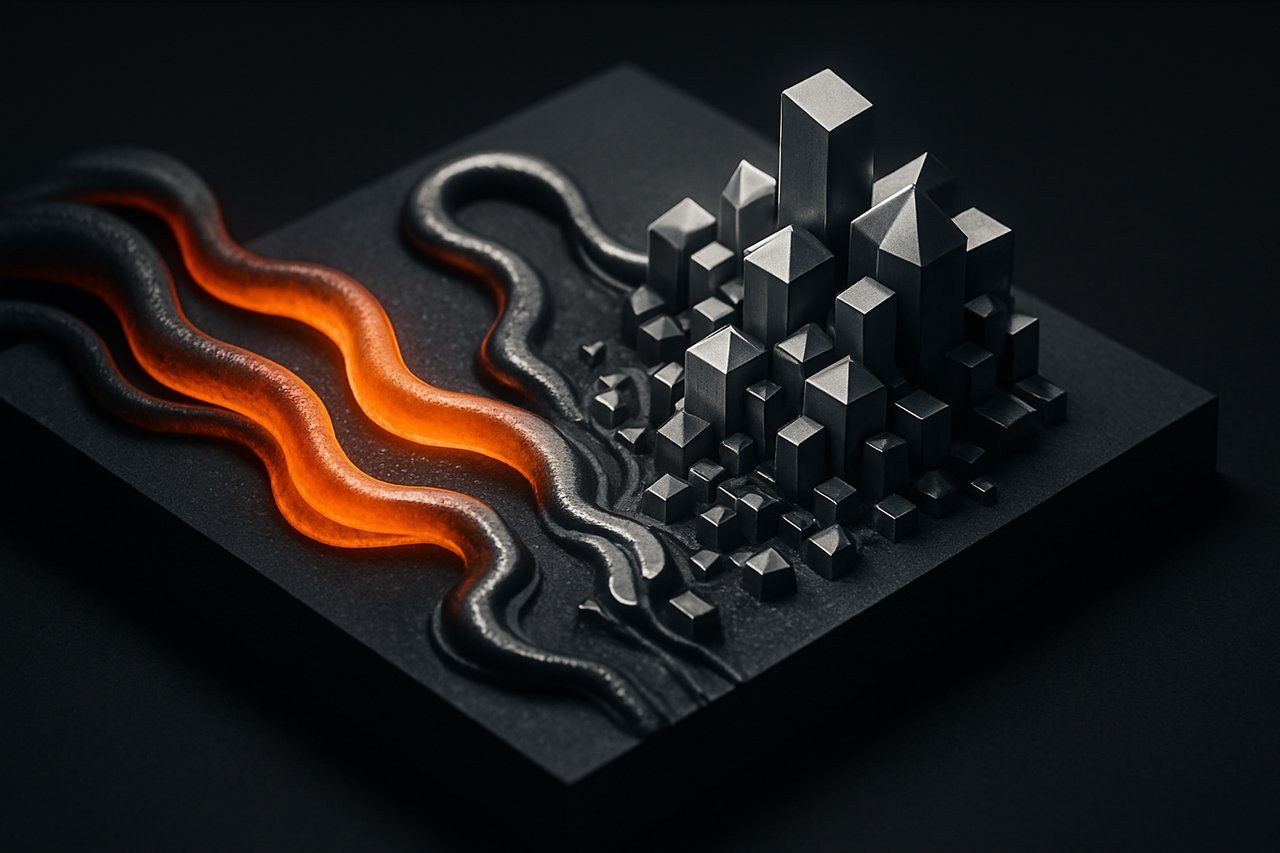
For decades, free-boundary problems have been a computational nightmare for engineers. Whether modeling melting glaciers, phase transition dynamics, or the behavior of molten metal in high-precision manufacturing, researchers always hit the same wall: the system's geometry changes simultaneously with its physical parameters. Traditional numerical methods in these scenarios are like trying to measure a writhing snake with a ruler—it is prohibitively expensive, slow, and requires remeshing the entire grid at every single step.
Scientific Machine Learning (SciML) suggests we stop patching old algorithms and instead pivot from function approximation to operator approximation. As Constantinos Siettos of the University of Naples Federico II highlights in Nature Machine Intelligence, this new approach relies on the principle of topological conjugacy. Rather than struggling with deformable domains, neural operators map chaotic dynamics onto a simplified, fixed geometry. This isn't just a "smart filter"; it is an attempt by neural networks to learn the underlying physical laws themselves, eliminating the need to retrain models for every new set of initial conditions.
The economics of this R&D breakthrough are clear: where a classical solver might hang for hours, neural operators deliver results in seconds. However, this speed comes at the cost of potential "physical hallucinations." Research by Lu and George Karniadakis indicates that the SciML field is still searching for the balance between computational audacity and strict adherence to conservation laws. Without rigorous methodological anchoring, a neural network might produce a scenario that looks visually plausible but is physically impossible.
In our view, this mathematical exercise is a direct precursor to truly autonomous production management systems. When an algorithm understands the physics of a process in real time, robotics evolves from a set of rigid scripts into an adaptive system capable of handling unpredictable materials and environments. The first players to integrate this framework into their industrial cycles will gain a competitive advantage that cannot be offset by simply increasing raw computing power.