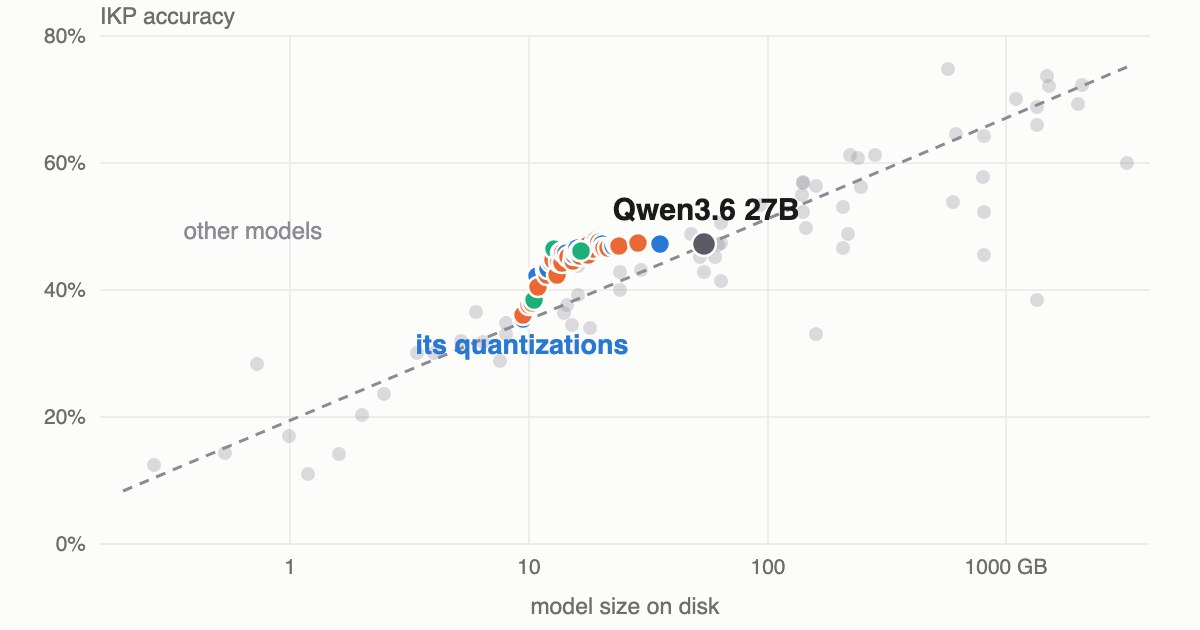
Cutting infrastructure costs by squeezing models into smaller bit-buckets is the industry’s favorite shell game, but the bill always comes due in factual accuracy. Analysis of Qwen3.6 27B via the Incompressible Knowledge Probes (IKP) benchmark—a 1,400-question gauntlet designed by Bojie Li—confirms a grim reality for CTOs: while logic might be flexible, facts are stubbornly incompressible. After testing 55 different quantizations from the likes of Unsloth and Bartowski, the verdict is clear: your model might still generate a perfect SVG pelican at 4 bits, but it will start hallucinating the geography of the Strait of Messina the moment you push the compression too far.
The data shows a violent, non-linear degradation. On hardware ranging from MacBook setups to Modal infrastructure, Qwen3.6 27B holds its ground as long as you stay above the 20 GB (5-bit) threshold. Move into the 3-bit or 2-bit wasteland, and the performance doesn't just dip—it craters. The model retains its 'reasoning' structure—it still sounds confident and writes clean Python—but the specific, niche data points that make an AI useful in a professional setting evaporate. This isn't a controlled optimization; it’s a blind pruning process that hacks away at token distributions without regard for the underlying training data.
For businesses, this creates a catastrophic failure point for RAG systems. If you aggressively quantize to save on CapEx, you end up with a high-speed engine fueled by bad data. The model stops relying on its internal weights for nuance and starts guessing, making it useless for identifying version-dependent API quirks or specific industry facts. Factual knowledge scales linearly with the logarithm of parameter counts; there is no magic shortcut.
Maximizing GPU RAM remains the only pragmatic move. If you are building for knowledge-intensive tasks, settle for nothing less than high-quality 4-bit (Q4_K_M) or 8-bit quantizations. Trying to cheat the physics of memory footprint won't result in a leaner system—it will just result in a more articulate liar. Physical memory is a non-negotiable tax on accuracy, and no amount of clever architectural gymnastics can circumvent the need for actual bits on the chip.