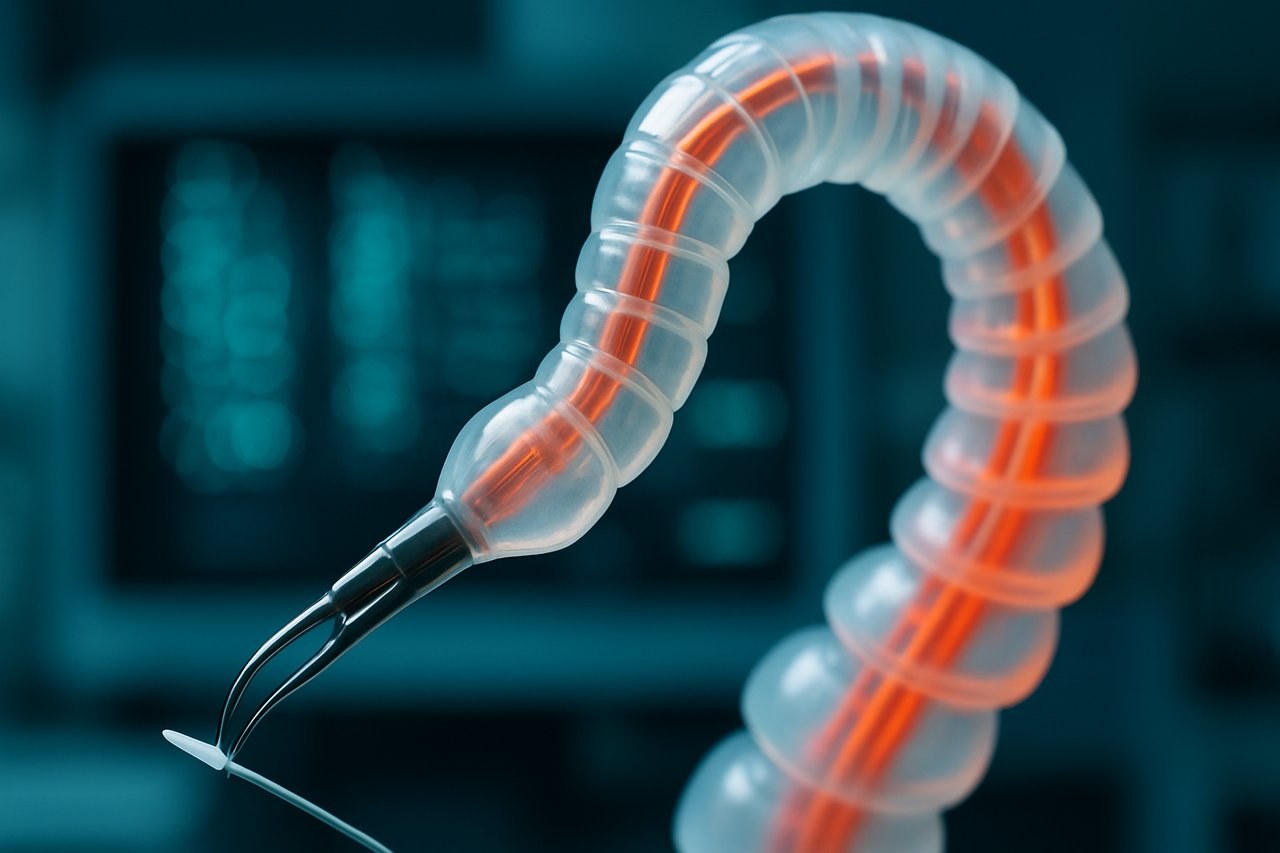
Traditional physical models for controlling flexible tension-driven robots have hit a computational wall. Researchers from the Universities of Utah and Vanderbilt—Branden Friederich, James M. Ferguson, Alan Kuntz, and Varun Shankar—point out that while relying on classical Cosserat rod theory accurately describes bending and torsion, it is prohibitively slow. In high-stakes environments like surgical theaters or complex technical inspections where split-second reactions are vital, these calculations become a liability.
Standard machine learning could solve the speed issue, but it remains pathologically inflexible. Even the slightest adjustment to a manipulator’s geometry—such as moving a spacer or rerouting a cable—renders a pre-trained model useless. This necessitates a full retraining cycle for every minor hardware iteration.
The real breakthrough lies in shifting from training specific hardware to the concept of Operator Learning. This involves training a neural operator that understands the physics of the entire design space. To overcome industry inertia, the team developed and benchmarked four architectures, including variations of Deep Operator Networks (DeepONets) and Fourier Neural Operators (FNO). Unlike classical neural networks that map vectors to vectors, these operators work with infinite-dimensional functional spaces. This allows the model to perceive design parameters—such as base length or actuator positioning—not as constants, but as input variables.
According to the study, supported by ARPA-H and the NSF, using FNO and DeepONet provides high-accuracy configuration forecasting for an entire class of devices without needing to retrain the system for every hardware update. For businesses in surgical and service robotics, this translates to a radical reduction in prototyping cycles. We are finally moving away from costly physical calibration toward autonomous control that adapts to structural changes on the fly.
From our perspective, this represents a major methodological shift: engineers are no longer building a model for one specific manipulator. Instead, they are creating surrogate mechanics capable of understanding the behavior of any robot in its class before it is even manufactured. Real-time path planning and design optimization for nonlinear flexible systems are finally becoming a practical reality rather than an academic exercise.