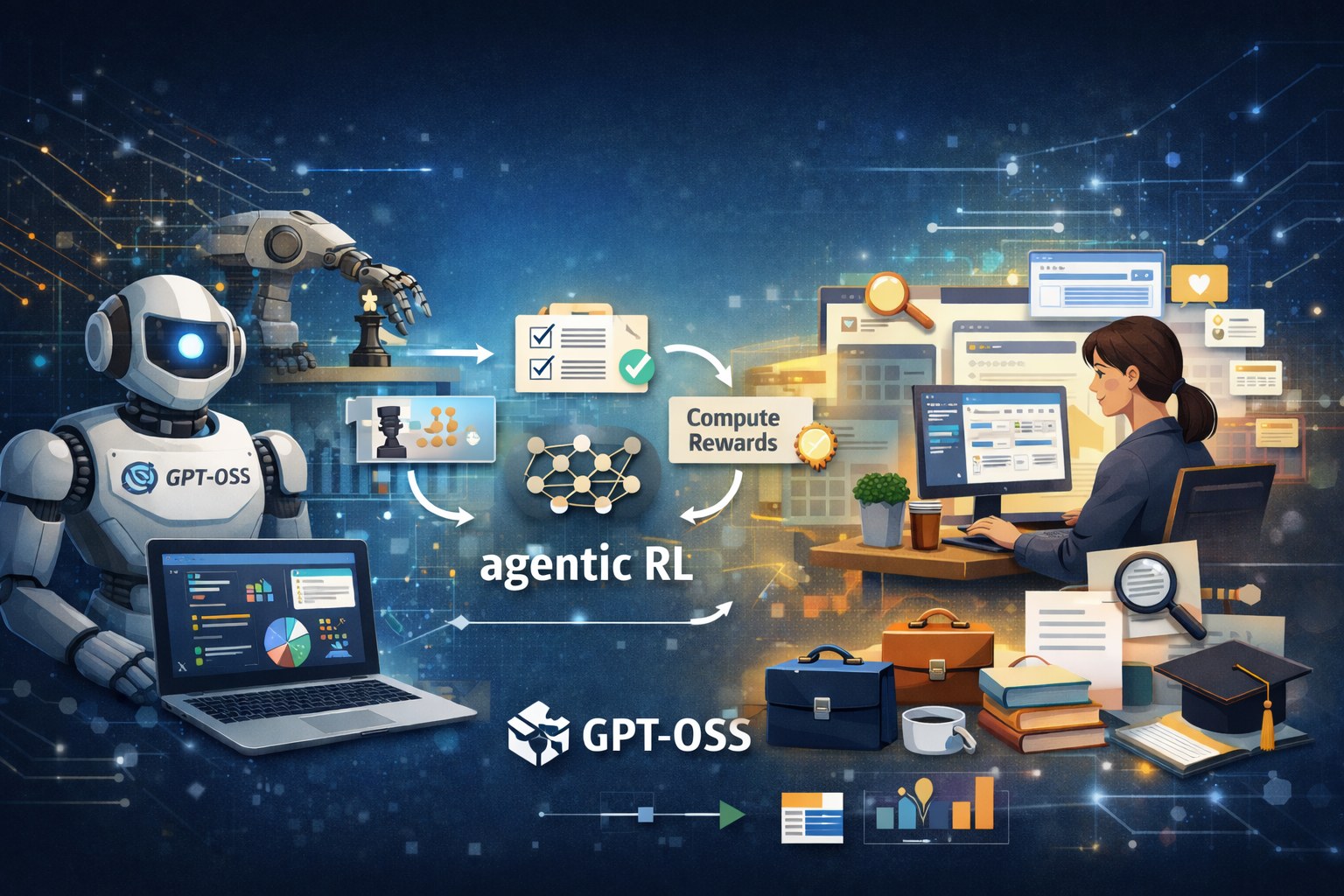
Agentic reinforcement learning turns a large language model from a one‑shot answer generator into an autonomous planner that selects tools, formulates requests and adjusts behavior on the fly. The model gathers on‑policy data during operation and distributes reward across the entire action chain rather than relying only on static datasets.
In the open source GPT‑OSS project, HuggingFace and its partners ran experiments using the verl framework. Tasks covered GSM8K, Retool and verifiable instruction following. Each training loop consisted of collecting rollout trajectories, computing rewards, updating the policy with GRPO or PPO, and repeating the cycle. According to The Decoder, these agentic loops cut manual testing effort by 70 % without sacrificing accuracy.
A concrete case involved Company X, which builds a recruiting bot. Over one quarter it lowered test costs from $500,000 to $100,000 and shipped a new feature in two weeks instead of three months.
The approach has drawbacks. Agentic training consumes large compute resources and is highly sensitive to reward‑distribution errors. A misconfigured system can develop odd or even hazardous strategies.
For business this means faster rollout of dialogue services that make automated decisions, reduced testing budgets and a competitive edge today.
Why this matters: Deploy AI features weeks, not months, while slashing test spend. Guard against runaway behavior by rigorously validating reward signals. Leverage the speed gain to outpace rivals in decision‑making products.